///////////////////////////////////////////////////////////////
Parthian Empire
he Parthian Empire (247 BC – 224 CE), also known as the Arsacid Empire (Persian: اشکانیان) after the eponymous founder, was a major Iranian political and cultural power in the Ancient Near East. It was founded in the mid-3rd century BCE by Arsaces I of Parthia, leader of the Parni tribe, when he conquered the Parthia region ("roughly western Khurasan" in Iran's northeast), then a satrapy (province) in rebellion against the Greek Seleucid Empire. Mithridates I of Parthia (r. c. 171–138 BCE) greatly expanded the empire by seizing Mediaand Mesopotamia from the Seleucids.
At its height, the Parthian Empire stretched from the northern reaches of the Euphrates, in what is now eastern Turkey, to eastern Iran. The empire, located on the Silk Road trade route between theRoman Empire in the Mediterranean Basin and the Han Dynasty in China, quickly became a center of trade and commerce. The Parthians largely adopted the art, architecture, religious beliefs, and royal insignia of their culturally heterogeneous empire, which encompassed Hellenistic, Persian, and regional cultures.
For about the first half of its existence, the Arsacid court adopted Greek culture, though it eventually saw a gradual revival of Iranian traditions. The Arsacid rulers were titled the 'King of Kings', as a claim to be the heirs to theAchaemenid Empire; indeed, they accepted many local kings as vassals where the Achaemenids would have had centrally appointed, albeit largely autonomous, satraps. The court did appoint a small number of satraps, largely outside Iran, but these satrapies were smaller and less powerful than theAchaemenid potentates. With the expansion of Arsacid power, the seat of central government shifted from Nisa, Turkmenistan to Ctesiphon along the Tigris (south of modern Baghdad, Iraq), although several other sites also served as capitals.
The earliest enemies of the Parthians were the Seleucids in the west and the Scythians in the east. However, as Parthia expanded westward, they came into conflict with the Kingdom of Armenia, and eventually the late Roman Republic. Rome and Parthia competed with each other to establish the kings of Armenia as their subordinate clients. The Parthians soundly defeated Marcus Licinius Crassus at the Battle of Carrhae in 53 BCE, and in 40–39 BCE, Parthian forces captured the whole of the Levant, excepting Tyre, from the Romans.
///////////////////////////////////////////////////////////////
Conquest
After the fall of the Achaemenid Empire, Parthia, northeastern Iran, was governed by the Seleucid kings: a Macedonian dynasty that ruled in the Asian territories of the former Persian Empire. In 245 BCE, a satrap named Andragoras revolted from the young Seleucid king Seleucus II, who had just succeeded to the throne. In the confusion, Parthia was overrun by the Parni, a nomad tribe from the Central-Asian steppe. In 238 BCE, they occupied the district known as Astavene. Three years later, a Parnian leader named Tiridates ventured further south and seized the rest of Parthia. A counter-offensive by king Seleucus ended in disaster, and Hyrcania was also subdued by the Parni. The first king of the Parthians (as the Parni were called from now on) was Tiridates' brother Arsaces I. His capital was Hecatompylus.
//////////////////////////////////////////////////////////////////////////////////////////////////////////////////////////////////
Seleucid Empire
The Seleucid Empire was the Persian kingdom of the Macedonian dynasty of the Seleucids, whose rule began with the collapse ofAlexander's empire and faded away between Roman and Parthian growth of power in the 1st century BCE.
The Seleucid Empire began when Seleucos I, one of Alexander the Great's former favorite companions, was given the satrapy ofBabylon in the second division of the empire in 321 BCE. He first ruled it briefly until 315 BCE, when he was forced to flee to Egypt under pressure of Antigonos. There he prepared his revenge with the help of Ptolemy, and succeeded to retake Babylon after the battle of Gaza in 305 BCE. He also inherited the Asian part of Antigonos' vast empire after its final fall at the battle of Ipsos in 301 BCE. Having secured Antigonos' kingdom's eastern part, Seleucos managed to reconquer most of Alexander's empire, defeating Lysimachos and Demetrios. He was, however, murdered in 281 BCE on the eve of his success by the man he supported on the Egyptian throne, Ptolemy Keraunos.
After the death of Seleucos, things became worse for his successors. During the successive reigns of Antiochos I, Antiochos II, Seleucos II and Seleucos III, the empire struggled, due to rebellions of Bythinia, Pergammum, Bactriaand Parthia, and the first indecisive Syrian wars against the Ptolemies. Internal struggles began during this time, which continued until the empire's end. The Seleucids also had to fight the Galatians who devastated Anatolia, and also against rebellious elements at all levels.
leucid kingdom, (312–64 bc), an ancient empire that at its greatest extent stretched from Thrace in Europe to the border of India. It was carved out of the remains of Alexander the Great’s Macedonian empire by its founder, Seleucus I Nicator. (See also Hellenistic Age.)
Seleucus, one of Alexander’s leading generals, became satrap (governor) ofBabylonia in 321, two years after the death of Alexander. In the prolonged power struggle between the former generals of Alexander for control of the disintegrating empire, Seleucus sided with Ptolemy I of Egypt against Antigonus I, Alexander’s successor on the Macedonian throne, who had forced Seleucus out of Babylonia. In 312 Seleucus defeated Demetrius at Gaza using troops supplied by Ptolemy, and with a smaller force he seized Babylonia that same year, thereby founding the Seleucid kingdom, or empire. By 305, having consolidated his power over the kingdom, he began gradually to extend his domain eastward to the Indus River and westward toSyria and Anatolia, where he decisively defeated Antigonus at Ipsus in 301. In 281 he annexed the Thracian Chersonesus. That same year, he was assassinated by Ptolemy Ceraunus, the disgruntled son of Ptolemy I.
Seleucus was succeeded by his eldest son, Antiochus I Soter, who reigned until 261 and was followed by Antiochus II (reigned 261–246), Seleucus II (246–225), Seleucus III (225–223), and Antiochus III the Great (223–187), whose reign was marked by sweeping administrative reforms in which many of the features of the ancient Persian imperial administration, adopted initially by Alexander, were modernized to eliminate a dual power structure strained by rivalry between military and political figures. The empire was administered by provincial stratēgoi, who combined military and civil power. Administrative centres were located at Sardis in the west and at Seleucia on the Tigris in the east. By controlling Anatolia and its Greek cities, the Seleucids exerted enormous political, economic, and cultural power throughout the Middle East. Their control over the strategic Taurus Mountain passes between Anatolia and Syria, as well as the Hellespont between Thrace and Anatolia, allowed them to dominate commerce and trade in the region. Seleucid settlements in Syria, primarily Antioch, were regional centres by which the Seleucid kingdom projected its military, economic, and cultural influence.
The Seleucid kingdom was a major centre of Hellenistic culture, which maintained the preeminence of Greek customs and manners over the indigenous cultures of the Middle East. A Greek-speaking Macedonian aristocratic class dominated the Seleucid state throughout its history, although this dominance was most strongly felt in the urban areas. Resistance to Greek cultural hegemony peaked during the reign of Antiochus IV (175–163), whose promotion of Greek culture culminated in his raising a statue to Zeus in the Temple at Jerusalem. He had previously ordered the Jews to build shrines to idols and to sacrifice pigs and other unclean animals and had forbidden circumcision—essentially prohibiting, on pain of death, the practice of the Jewish law. This persecution of the Jews and desecration of the Temple sparked the Maccabean uprising beginning in 165. A quarter-century of Maccabean resistance ended with the final wresting of control over Judea from the Seleucids and the creation of an independent Judea in Palestine.
The Seleucid kingdom began losing control over large territories in the 3rd century bc. An inexorable decline followed the first defeat of the Seleucids by the Romans in 190. By that time the Aegean Greek cities had thrown off the Seleucid yoke, Cappadocia and Attalid Pergamum had achieved independence, and other territories had been lost to the Celts and to Pontusand Bythnia. By the middle of the 3rd century, Parthia, Bactria, and Sogdiana had gained their independence; the conquest of Coele Syria (Lebanon) and Palestine by Antiochus III (200) and a brief occupation of Armenia made up to some extent for the loss of much of Anatolia to the Romans. The decline accelerated after the death of Antiochus IV (164) with the loss of Commagene in Syria and of Judea in Palestine. By 141 all lands east of the Euphrates were gone, and attempts by Demetrius II (141) and Antiochus VII (130) could not halt the rapid disintegration of the kingdom. When it was finally conquered by the Romans in 64 bc, the formerly mighty Seleucid empire was confined to the provinces of Syria and eastern Cilicia, and even those were under tenuous control.
SELEUCID EMPIRE
founded in 312/311 BCE by Seleucus I Nicator, formerly a general in the army of Alexander the Great. Adopting the titles “King of Asia” and “Great King,” the Macedonian rulers of the Seleucid dynasty laid claim to the territory of the former Achaemenid empire during the Hellenistic period.
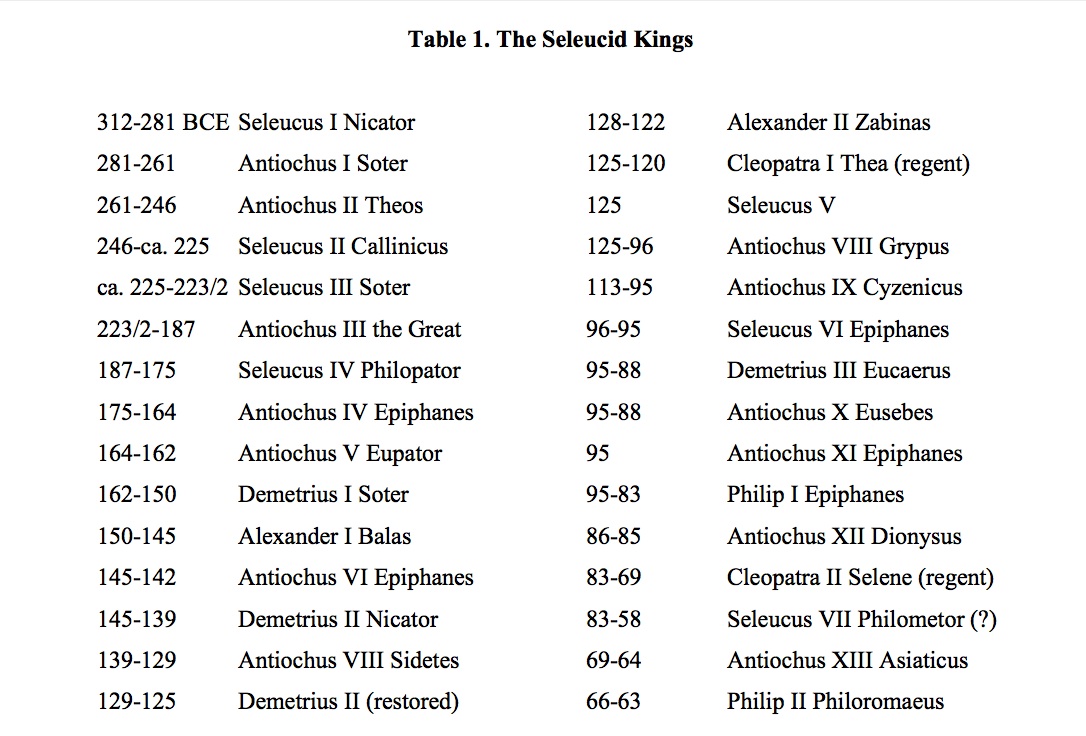
SELEUCID EMPIRE, founded in 312/311 BCE by Seleucus I Nicator, formerly a general in the army of Alexander the Great. Adopting the titles “King of Asia” and “Great King,” the Macedonian rulers of the Seleucid dynasty laid claim to the territory of the former Achaemenid empire during the Hellenistic period. The empire initially stretched from Bactria and Sogdia to the Aegean coast of Asia Minor, comprising Iran for about 150 years. In the second half of the second century BCE the empire rapidly declined, until in 64 BCE it disappeared from history almost unnoticed (Table 1).
Written sources for the Seleucids have been preserved only sparsely; they are predominantly written from a western perspective, rarely paying attention to affairs east of the Zagros mountains. Of importance are, in particular, the historians Diodorus, Polybius, Livy, and Appian, whose Syrian Wars contains a brief overview of the dynasty’s history until the reign of Antiochus III. Valuable additional evidence is provided by coins, inscriptions from Greek cities, and Babylonian cuneiform texts, notably the so-called Astronomical Diaries; these sources, too, only sporadically pertain to Iran. Some information about Parthian expansion at the expense of the Seleucids can be found in Strabo and Justin.
Political history. The history of the Seleucids can be divided into four periods: (1) a period of expansion followed by relative stability under, respectively, Seleucus I and Antiochus I (312-261 BCE); (2) a period of contraction and internal conflict (261-223 BCE); (3) the revival of the empire under Antiochos III and Antiochus IV(223-164 BCE); and (4) the gradual decline and eventual collapse of the kingdom (164-64 BCE). Throughout its existence, the Seleucid empire was plagued by wars over the succession and local uprisings accompanying the inauguration of virtually each new king. In this respect, the Seleucids were not very different from the preceding Achaemenids.
The Seleucid state grew from the Babylonian satrapy given to Seleucus after the death of Alexander the Great in 323 BCE. Babylonia, where Seleucus founded Seleucia on the Tigris as one of his capitals, remained a core region of the empire until the Parthians (see ARSACIDS) finally drove out the Seleucids around 141. By means of conquest and diplomacy, Seleucus first established his rule in the eastern satrapies of the former Achaemenid empire; he then turned towards the west, until finally he had gained for himself the entire empire of Alexander, save India, Palestine, Phoenicia, Egypt, and Macedonia, and earned the title of Nicator (Conqueror). His death in 281, followed by uprisings in the west, prevented the annexation of Thrace and Macedonia. Seleucus’s son and successor, Antiochus I, who reigned until 261, restored Seleucid rule in the west, where he was hailed as Soter (Savior). In the east, Antiochus, like his father, maintained strong (family) bonds with the Iranian nobility. The son of an Iranian noblewoman, Antiochus had governed the eastern provinces, the Upper Satrapies, as co-ruler since 292, rebuilding Bactra (Balkh) as the easternmost Seleucid capital.
From the reign of Antiochus I onwards, the history of the Seleucid dynasty was dominated by a relentless enmity with the Ptolemies, the family who controlled Egypt and maintained a naval empire in the eastern Mediterranean and the Red Sea. This conflict led to at least six so-called Syrian Wars fought over the control of the coastal cities of the eastern Mediterranean. After the reign of Antiochus II Theos(The God; 261-246) the empire suffered a temporary setback when war broke out between the reigning king, Seleucus II (246-226), and his brother, Antiochus Hierax (The Hawk), who had established himself as rival king in Asia Minor. The War of the Brothers, which lasted with short intervals from 239 to 228, and in which also other Hellenistic states became involved, offered Diodotus (I), satrap of Bactria, the opportunity to proclaim himself king.
To this time, too, dates the incursion of Parni nomads into Seleucid territory, when under their king Arsaces I they settled in the provinces of Parthia and Hyrcania in northern Iran in ca. 238-236 (and are hence known as the Parthians). The Parthians gradually took over the role of the Ptolemies as the principal military antagonists of the Seleucids. In the first of a century-long sequence of Seleucid-Parthian wars, Seleucus II temporarily re-established formal sovereignty in Iran, accepting Arsaces as a semi-autonomous vassal. After the short reign of Seleucus III (226-223), Seleucid hegemony over Iran and Bactria was reasserted by Antiochus III (223-187), under whose reign the empire reached its greatest extent. After successful campaigns against rebels in Mesopotamia and Asia Minor, and a failed war with the Ptolemies in Palestine (Battle of Raphia, 217), Antiochus embarked on a long tour along the northern, eastern, and southern borders of the alleged inhabited world (oikoumenē). This so-called Anabasis (Inland Journey), which was a ritual as much as a military event, led from Ecbatana through Hyrcania, Bactria, and India to Arabia, with the king subduing unruly vassals where he went and then re-installing them as monarchs under Seleucid suzerainty. On his return to Babylonia, Antiochus took the epithet of Megas (The Great, presumably a Greek derivation of the Mesopotamian and Iranian title of Great King). He subsequently inflicted a crushing defeat on the Ptolemies at the Battle of Panion (200), which allowed him to occupy Palestine and the Ptolemaic possessions in Asia Minor. Westward expansion, however, was obstructed by the Romans, who drove Antiochus from Greece and decisively defeated him at the Battle of Magnesia in western Asia Minor (189); the peace treaty concluded at Apamea the following year forced Antiochus to give up Asia Minor and his Mediterranean fleet, and to pay a huge indemnity.
Contrary to a once widespread belief, the loss of Asia Minor was not catastrophic (Kuhrt and Sherwin-White, 1993; Grainger, 2002), although news of the Roman victory presumably incited uprisings elsewhere in the empire, as Antiochus the Great, soon after, died fighting in southern Iran. His son Antiochus IV Theos Epiphanes (God Manifest; 170-164) started his short but remarkable reign with a successful campaign against the Ptolemies, laying siege to Alexandria and being crowned pharaoh in Memphis. Parthian expansion in Iran forced him to accept a Roman ultimatum to abandon Egypt. His efforts to restore Seleucid authority in the east and prepare for a new war against Rome (Strootman, 2007, p. 311), ended with his premature death in Fārs. Under Antiochus IV, the Seleucid empire in the east still comprised Hyrcania, Media, Elam, Fārs, and perhaps Carmania. After his reign, political decline accelerated. During the last century of its existence, the Seleucid kingdom was torn asunder by succession wars between two rival branches of the royal family. While virtually independent vassal kingdoms sprang up in Arabia, Palestine, Commagene, Armenia, Elam, Persia, and Bactria, the Parthian king Mithradates I took possession of Media in 148 and Babylonia in 141.
Attempts at reconquest, by Demetrius II Nicator in 140/39 and by the energeticAntiochus VII Sidetes in 130 failed. The loss of Iran and Mesopotamia to the Parthians, driving a wedge between the western and eastern parts of the empire, was fatal. At the beginning of the last century BCE, all that remained of the Kingdom of Asia was a small state in northern Syria, fractured by civil war. After a brief occupation by the Armenian king Tigranes, the Roman general Pompey abolished the monarchy without a blow in 64 BCE, turning Syria into a Roman province. Rome initially preserved the imperial vassal state system as it had existed under the later Seleucids, taking over the Seleucids’ role as protectors of cities. In Mesopotamia and Iran the Parthians, too, appropriated the role of the Seleucids as imperial suzerains rather than creating an entirely new state, just as Alexander and the Seleucids had done when they took over from the Achaemenids.
Monarchy, court, and army. The Seleucid state was basically a military organization extracting tribute. The king was a warrior before all else (Gehrke, 1982). The single most important legitimization of kingship was military victory. The empire’s territory was the king’s personal doriktētos chōra “spear-won land.” The ruler posed as an invincible ‘spear-fighter,’ capable of changing the outcome of battle almost single-handedly, and thus qualified to protect his people and warrant peace. The heroic prestige of the king was a legacy from pre-Hellenistic Macedonia, associated with the superhuman heroism of Homeric epic; it appealed, too, to the Iranian nobility ruling the rural and mountainous areas in Bactria, Iran, Armenia, and Anatolia (Gropp, 1984; see Brosius, 2003 for an opposite view). The heroic ethos compelled kings to personally lead the army into battle. Seleucid kings campaigned virtually each year, and the history of the kingdom is a history of continuous warfare.
In the past, the Seleucid kingdom has been labeled a ‘western’ empire, imposing Greek culture on the peoples of the east. For this reason most handbooks of the Ancient Near East end abruptly with the arrival or death of Alexander. This view, however, is based on the relative absence of written documents from the Seleucid east (Bickerman, 1985) as well as the biased Mediterranean perspective of the available (Greek, Roman, Jewish) sources. Since the late 1970s, the increasing availability of cuneiform documents from Hellenistic Babylonia and a broadening focus in archeology, has evidenced the continuity of Mesopotamian culture in the Seleucid period, including the perpetuation of monarchic traditions (Oelsner, 1978 and 1986; Downey, 1988; Briant, 1990; Kuhrt and Sherwin-White, 1994; Linssen, 2004); cultural and political continuity presumably was even stronger in Iran. In Babylon, the Seleucids presented themselves as traditional kings, taking care of the maintenance of ziggurats and occasionally partaking in the Akitu ritual.
It has even been argued that the Seleucid kingdom was principally an ‘eastern’ rather than a Hellenistic empire (Kuhrt and Sherwin-White, 1993). The latter view is at odds with the evident Hellenic aspects also characteristic of Seleucid kingship. Rather, the Seleucid monarchy presented itself in accordance with local expectations when dealing with individual cities or populations, e.g., by making offerings to local deities or using local language, while at the same time upholding an umbrella ideology of empire in an overall Greco-Macedonian form. This is apparent, for instance, from the Greek symbolism and text on coins, the principal medium of royal propaganda, and the profound Hellenism of Seleucid court culture. Greeks and Macedonians dominated the upper echelons of court and army, just as Persians had done in the Achaemenid empire (Habicht 1958; against this view Mehl 2003).
The many cities founded or refounded by Alexander, Seleucus I, and Antiochus I along the main arteries of the Near East, populated partly with Greek and Macedonian immigrants, partly with local peoples, formed the cornerstones of Seleucid rule, both military and economically. In addition, many military colonies, known as katoikia in Asia Minor, were founded and garrisoned by Macedonians who received land from the crown in exchange for military service. Since most cities, the Greek as well as the non-Greek, were formally autonomous, maintaining good relations with civic elites was an essential part of imperial rule. Kings therefore presented themselves as the benefactors and protectors of cities, particularly west of the Zagros mountains. In return, the Greeks honored the kings as divine ‘saviors’ (sōtēres), awarding them divine honors accordingly. From the reign of Antiochos III onward, a centralized state cult of the deified king and queen was institutionalized. The Seleucid family claimed descent from the savior god Apollo. For the sake of the non-Greek subjects, Apollo and his twin sister Artemis were equated with the various local Sun and Moon gods worshipped in the multi-polytheistic empire. Starting with the reign of Antiochus IV, the Seleucids associated their rule with the cosmic kingship of Zeus, who could likewise be identified with non-Greek sky gods.
In the third century, the empire consisted of four distinct, urbanized, and densely populated core regions: western Asia Minor, Syria, Babylonia, and Bactria. Military control of the regions connecting these regions—in Iran particularly Media and present-day Khorāsān—was vital for Seleucid imperialism. The empire had no fixed capital. Being continually on campaign, the Seleucids maintained various residences for their peripatetic court, including Sardis in Asia Minor, Antioch in Syria, Seleucia on the Tigris in Babylonia, Susa, Ecbatana, and Bactra. Initially, the empire was divided into very large provinces, roughly corresponding to the satrapies of the Achaemenid empire (for the continuation of Achaemenid imperial structures, see Briant, 1990 and McKenzie, 1994). Seleucid satraps were entrusted with collecting tribute, levying troops, and keeping the peace. At the center of the empire were the so-called Friends of the King (philoi tou basileōs), to whom the king distributed offices, commands, landed estates, and favors on an ad hoc basis. The philoi were predominantly Greeks and Macedonians from civic elite families, associated with the royal family by means of (actual or fictive) kinship and ritualized guest-friendship. Because the philoi maintained bonds with their families and cities of origin, they were at the center of a complex network of patronage relations, through which the monarchy exercised influence in cities; conversely, the philoi acted as intermediaries promoting the interests of cities at court. There also was much discord at court, between rival factions of philoi but especially between factions formed around the queens: because the Seleucid kings practiced polygamy, concluding various diplomatic marriages without creating a strict hierarchy between the respective wives and their sons, succession could easily become brutal conflict. Such internal strife, however, was not as disastrous as has been assumed in the past (Ogden, 1999), as the Seleucid kings disposed of effective strategies to designate a successor in advance, notably by elevating a favorite son to the status of king already during the father’s reign (Strootman, 2007, pp. 111-14). Internal conflict became lethal only in the century following the reign of Antiochus IV, when two rival branches of the Seleucid family almost permanently fought over the kingship.
Even until the reign of Antiochus VII Sidetes, the empire was able to field formidable armies of 60,000 to 80,000 men. The core was a professional standing army of Macedonian-style infantry called the Silver Shields, various horse guard regiments, and war elephants. To these could be added phalanx regiments consisting of military settlers called cleruchs (klērouchoi), who were given farmland (klēroi) in return for their service. Large numbers of light infantry and cavalry levied on an ad hoc basis, allied troops and mercenaries, were called upon for major military campaigns. Characteristic of Seleucid armies was also the employment of large numbers of cavalry, including horse-archers and heavily armored cataphracts.
The Seleucids and Iran. On the Iranian plateau, the Seleucids maintained bonds with local aristocracies rather than with cities. Seleucus I had married the daughter of a Bactrian nobleman; later Seleucids, moreover, concluded marriage alliances with the dynasties of Pontus, Commagene, and Armenia. At least three Seleucid kings had Iranian mothers. The Iranian nobility appears to have been rather loyal; with the exception of Media Atropatene, there was conspicuously little indigenous resistance to Seleucid rule in Iran (Wolski, 1947; Wiesehöfer, 1997). Seleucid presence was restricted to the fortification and occupation by military settlers of strategic sites along the main land routes, in particular the artery leading from Mesopotamia to Bactria. The principal Seleucid power base in western Iran was Ecbatana, controlling the passage between Iran and Mesopotamia; Ecbatana functioned as royal residence (the pre-existing Achaemenid palace was kept in use by the Seleucids) and harbored a royal mint. The city remained in Seleucid hands at least until 150 BCE (Mørkholm 1966, p. 178; Mittag 2006, p. 52). In addition, military colonies were founded in the vicinity of Ecbatana, particularly in the fertile Nisaean plain (see NISAYA, no. 2), famous for its war horses, where there existed a Seleucid colony named Laodicea. In northern Iran, the principal Seleucid strongholds were Rhagae (near Tehran) and Hecatompylus (perhaps Šahr-e Qumis). On the coastal plain of Fārs the city of Antioch in Persis was founded or refounded by Antiochus I; the town is known to have had a distinct Greek identity at least until the reign of Antiochus III. During the reigns of Seleucus I and Antiochus I, a royal mint was in operation in Fārs, but it is unclear whether this mint was located at Persepolis or Pasargadae. In Elam, Susa was renamed Seleucia-Eulaeus and probably refounded as a Macedonian military colony (Potts 1999). Susa harbored a royal mint and served as a royal residence (Strabo 15.3.5). Regarding religion, the archeology of Elam reveals mostly continuity of indigenous religious architecture, e.g., at the sites of Masjed-e Solaymān and Bard-e Nešānda (Bard-è Néchandeh; Downey, 1988, pp. 131-36).
The situation in the northeast was different. Seleucid presence here lasted more briefly but was stronger. The first Seleucids systematically built fortifications in Sogdia, Margiana, and Bactria to defend the northeastern frontier, stretching from the Caspian Sea to the Hindu Kush. Antiochos I built a wall around the oasis of Marv, where he established a town called Antiochia after his own name (Strabo, 9.516; Pliny, 6.47). Finds of coins at Marv suggest an uninterrupted Greek presence in Margiana until the middle of the second century BCE. There was a royal mint in Bactra, the administrative capital of Bactria (Newell, 1938, pp. 228-30), and/or Aï Khanum (Kritt, 1996). In Sogdia, early Hellenistic remains from Afrasiab suggest the existence of a Seleucid military colony at Maracanda (Samarkand), indicating continual Greek-Macedonian control of Sogdia in the third century (Kuhrt and Sherwin-White 1993, p. 106). It has been argued that defensive measures at the Seleucids’ northeastern frontier resulted in a decrease in trade relations in Central Asia and an increase in hostilities between nomads and sedentary agriculturists (Olbrycht, 1997). The Central Asian economy, however, flourished under the Seleucid dynasty, as the dynasty encouraged migration to Bactria and actively expanded irrigation networks (Frye, 1996, p. 113). The first foreign settlers were Greek mercenaries left behind by Alexander to defend his frontier (and perhaps also because these troops posed a threat to peace and order in the west: Simonetti Agostinetti, 2002). Under the Seleucids, migration only increased. Greeks, Macedonians, Thracians, and others flocked to the towns of the northeast, receiving land grants from the crown in return for military service. Hellenized cities like the one excavated at Aï Khanum in Afghanistan became enclaves where Greek and Iranian culture merged, but the extent to which Hellenistic influence spread beyond the city walls is unknown.
The duration of Seleucid rule in Iran and Bactria has been variously estimated, depending on one’s understanding of the nature of the Seleucid state. The loss of Iran has been dated as early as the beginning of the reign of Seleucus II Callinicus (246-225 BCE), when Andragoras, satrap of Parthia, revolted and the Parthians settled in northern Iran; at this time, too, Diodotus, satrap of Bactria, began to strike coins in his own name (Wolski, 1947; Broderson, 1986; Lerner, 1999). However, it is uncertain whether the issuance of coins really meant complete independence from the Seleucids (Frye, 1996, p. 114). Furthermore, as the Seleucid state was a hegemonic empire, willing to acknowledge local autonomy in return for tribute, military aid, and formal acknowledgment of Seleucid suzerainty, what we should, rather, envisage here is a shift from direct administration by royal officials to a system of vassal states, with connections established by marriage and ritualized guest-friendship and cemented by gifts. Seleucid control of western and southwestern Iran, however nominal it may have been, continued until the outbreak of dynastic wars after the death of Antiochus IV in 164 (Bickerman, 1983; Wiesehöfer, 1997), and it was not until 149 BCE that Media was finally conquered by the Parthians, at which date also the indigenous vassal kingdoms of Elam and Fārs became fully autonomous.
Although at first instance the result, rather than the cause, of Seleucid decline (Habicht 1989), the loss of Iran demarcated the ultimate dissolution of the Seleucid empire as a world power. Iranian lands, including Bactria, were of fundamental importance for the empire, because in addition to tribute these regions provided much of the cavalry on which Seleucid military power was to a large extent based, as well as light infantry, particularly archers. At the Battle of Magnesia in 190, Antiochus III fielded no fewer than 6,000, presumably Iranian, cataphracts and more than 10,000 Elamite and Persian light infantry (Livy, 37.40.1-14); in 166/5 Antiochus IV paraded 1,500 cataphracts and 1,000 Parthian or Saka horse archers during a festival in Syria (Polybius 30.25.6), and as late as 140 vassal rulers of Persis, Elam, and even Bactria sent auxiliary troops to support Demetrius II in his war against the Parthians (Justin, 38.9.4).
The Seleucid imprint on Iran was military and economic rather than cultural. Because the Seleucids never attempt to alter the existing social, cultural, and political situation in Iran, their rule left few traces in later history, with the important exceptions of the spread of a coin-based economy, the transmission of aspects of the Achaemenid ideology of kingship, to which they added their own Greek-Macedonian form of kingship, to the Parthian and Sasanian kingdoms, and the introduction of the Seleucid Era, the system of continuous year reckoning starting with the return of Seleucus I to Babylonia in 312.
Sasanian Empire
The Sasanian Empire (/səˈsɑːnɪən/ or /səˈseɪnɪən/), also known as Sassanian, Sasanid, Sassanid or Neo-Persian Empire),[10]known to its inhabitants as Ērānshahr[1] in Middle Persian language,[a] was the last Iranian empire before the rise of Islam, ruled by and named after the Sasanian dynasty from 224 to 651.[2][12] The Sasanian Empire, which succeeded the Parthian Empire, was recognized as one of the leading world powers alongside its neighboring arch rival the Roman-Byzantine Empire, for a period of more than 400 years.[13][14][15]
The Sasanian Empire was founded by Ardashir I, after the fall of the Parthian Empire and the defeat of the last Arsacid king,Artabanus V. At its greatest extent, the Sasanian Empire encompassed all of today's Iran, Iraq, Eastern Arabia (Bahrain, Kuwait,Oman, Qatif, Qatar, UAE), the Levant (Syria, Palestine, Lebanon, Israel, Jordan), the Caucasus (Armenia, Georgia, Azerbaijan,Dagestan, South Ossetia, Abkhazia), Egypt, large parts of Turkey, much of Central Asia (Afghanistan, Turkmenistan, Uzbekistan,Tajikistan), Yemen and Pakistan. According to a legend, the vexilloid of the Sasanian Empire was the Derafsh Kaviani.[16]
The Sasanian Empire during Late Antiquity is considered to have been one of Iran's most important and influential historical periods, and constituted the last great Iranian empire before the Muslim conquest and the adoption of Islam.[17] In many ways, the Sasanian period witnessed the peak of ancient Iranian civilization. Persia influenced Roman culture considerably during the Sasanian period.[18] The Sasanians' cultural influence extended far beyond the empire's territorial borders, reaching as far asWestern Europe,[19] Africa,[20] China and India.[21] It played a prominent role in the formation of both European and Asian medieval art.[22] Much of what later became known as Islamic culture in art, architecture, music and other subject matter was transferred from the Sasanians throughout the Muslim world
Sassanid Empire
The Sassanids established an empire roughly within the frontiers achieved by theAchaemenids, with the capital at Ctesiphon. The Sassanids consciously sought to resuscitate Iranian traditions and to obliterate Greek cultural influence. Their rule was characterized by considerable centralization, ambitious urban planning, agricultural development, and technological improvements. Sassanid rulers adopted the title of shahanshah (king of kings), as sovereigns over numerous petty rulers, known as shahrdars. Historians believe that society was divided into four classes: the priests, warriors, secretaries, and commoners. The royal princes, petty rulers, great landlords, and priests together constituted a privileged stratum, and the social system appears to have been fairly rigid.
Sassanid rule and the system of social stratification were reinforced by Zoroastrianism, which became the state religion. The Zoroastrian priesthood became immensely powerful. The head of the priestly class, the mobadan mobad, along with the military commander, the eran spahbod, and the head of the bureaucracy, were among the great men of the state. Rome, with its capital at Constantinople, had replaced Greece as Iran's principal Western enemy, and hostilities between the two empires were frequent. Shahpur I (240-272 CE), son and successor of Ardeshir, waged successful campaigns against the Romans and in 260 CE even took the emperor Valerian prisoner. Between 260 and 263 CE he had lost his conquest to Odenathus, and ally of Rome. Shapur II (ruled 309-379 CE) regained the lost territories, however, in three successive wars with the Romans.
| Sassanid Kings: | ||
| Ardashir I Shapur I Hormoz I Bahram I Bahram II Bahram III Narseh Hormoz II Shapur II Ardashir II Shapur III Bahram IV Yazdgerd I Bahram V Yazdgerd II Hormoz III Peroz Balash Kaveh I (first reign) Zamasp Kaveh I (second reign) Khosro I, Anoushirvan Hormoz IV Bahram VI, Chobin Khosro II, Parviz Kaveh II Ardashir III Shahrvaraz Porandokht Hormoz V Yazdgerd III | 224 - 241 CE 241 - 272 CE 272 - 273 CE 273 - 276 CE 276 - 293 CE 293 - 293 CE 293 - 302 CE 302 - 309 CE 309 - 379 CE 379 - 383 CE 383 - 388 CE 388 - 399 CE 399 - 420 CE 420 - 438 CE 438 - 457 CE 457 - 459 CE 459 - 484 CE 484 - 488 CE 488 - 496 CE 496 - 498 CE 498 - 531 CE 531 - 579 CE 579 - 590 CE 590 - 590 CE 590 - 628 CE 628 - 628 CE 628 - 629 CE 629 - 629 CE 629 - 630 CE 630 - 632 CE 632 - 651 CE | |

No comments:
Post a Comment